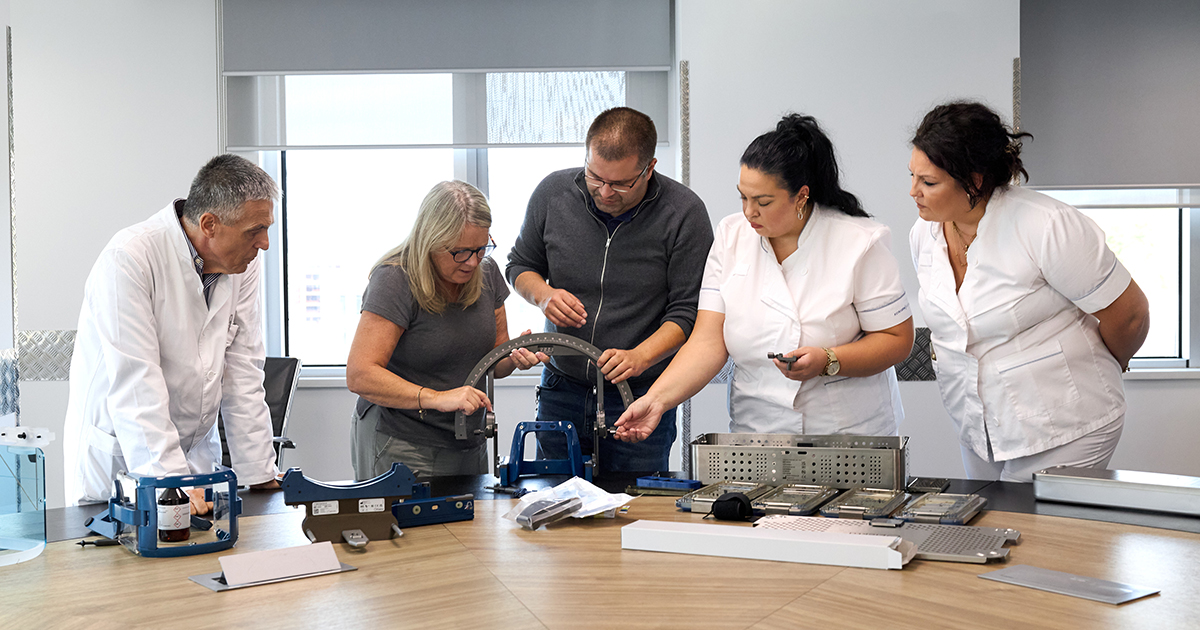
Acibadem Sistina Hospital hosted a specialized training on the Leksell Vantage Stereotactic System, a modern system designed for stereotactic neurosurgery and used in precise neurosurgical interventions.
The training is part of the hospital's preparations to introduce Deep Brain Stimulation (DBS) as a therapeutic option for carefully selected patients with Parkinson's disease. The training was led by Patti Batchelder, a neuro-application specialist at the renowned company Elekta, who worked with the Acibadem Sistina team on the practical application of the system and its use in the planning and implementation of high-precision stereotactic neurosurgical procedures..jpg)
"By procuring the modern stereotactic system and the training provided to the entire team, we are creating conditions to introduce deep brain stimulation at our hospital as well. It is a highly specialized procedure requiring exceptional precision, careful planning, and close collaboration among neurosurgeons, neurologists, radiologists, and other medical staff. Our goal is to provide a modern therapeutic option for carefully selected patients with Parkinson's disease—one that can significantly contribute to better control of motor symptoms and an improved quality of life", says Assoc. Prof. Milenko Kostov, MD, a neurosurgeon.
During the training, the multidisciplinary team of medical experts familiarized themselves with the proper preparation, setting up, and use of the stereotactic system, as well as its integration into radiological imaging and the planning of neurosurgical procedures..jpg)
"DBS is a functional neurosurgery method in which thin electrodes are placed into precisely defined structures deep within the brain; these are connected via subcutaneous extensions to a small neurostimulator implanted under the skin in the region below the clavicle. The system can be simply described as a pacemaker for the brain. Unlike classic surgical procedures that create a permanent lesion in the brain tissue, DBS does not destroy the brain structure. Instead, through controlled electrical impulses it changes the activity of the neural networks involved in generating the symptoms of Parkinson's disease. The most common targets for stimulation are structures within the basal ganglia that play a central role in the control and coordination of movement", says Assoc. Prof. Milenko Kostov, MD, a neurosurgeon.
Introducing this technology, Acibadem Sistina Hospital continues to advance complex neurosurgical procedures and invest in state-of-the-art medical equipment, staff training, and a multidisciplinary approach to patient treatment.


Copyright © 2026 Developed by Unet All rights reserved.



.png)